

Context
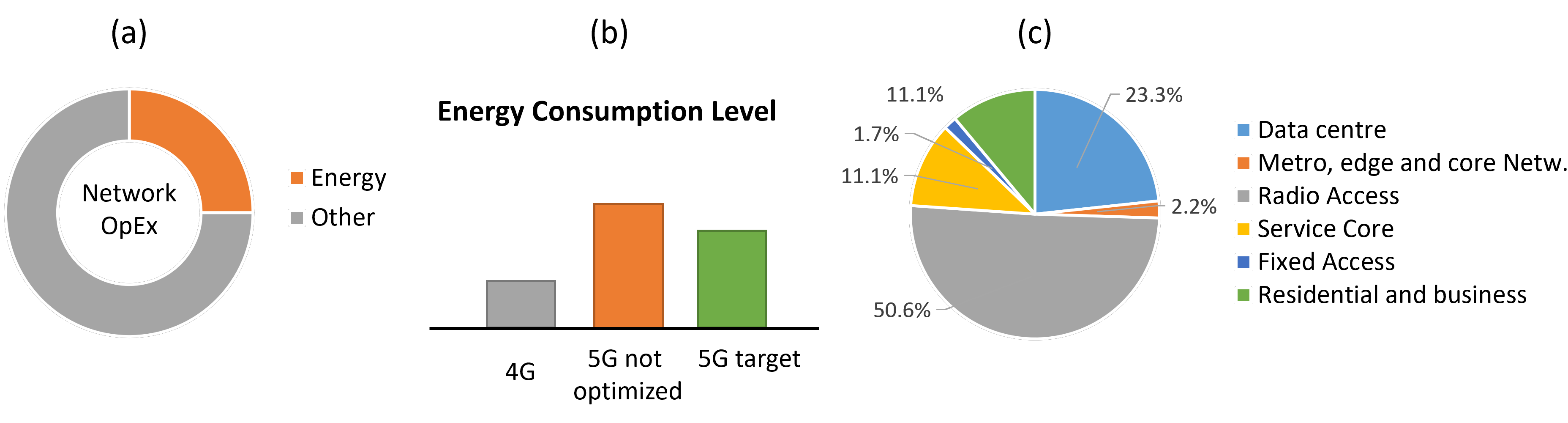
The Fifth-Generation (5G) of radio mobile networks and edge computing technologies are the two key enablers transforming the cloud into a flexible communication and inter-compute continuum, offering the possibility to introduce radically new applications in any vertical industrial domain. Recent studies indicate that the intrinsic distributed and pervasive nature of 5/6G and edge computing are going to cause a noticeable usage and deployment increase of computing resources, increasing the associated infrastructure OpEx and CapEx, and, consequently, their carbon footprint and energy requirements.
The rise of edge computing is further affecting the infrastructure and its impact on energy consumption and GreenHouse Gas (GHG) emissions, leading to an edge-cloud continuum composed of a large number of public/private micro/small/medium datacenters. Since, in 5G, edge facilities should be dimensioned against the workload produced by locally connected mobile users and their (edge) applications, The edge part of the 5/6G continuum cannot benefit from workload aggregation, and it will sensibly affect the sustainability of the ecosystem.
To cope with this problem and to meet sustainable growth targets of both the ONU 2030 Agenda and the European Green Deal, the 5/6G continuum needs to rapidly evolve new foundation paradigms specifically addressing energy and carbon footprints of the overall ecosystem.
6Green Objectives
The 6Green project aimed to conceive, design, and realize an innovative service-based and holistic ecosystem capable of extending the communication infrastructure into a sustainable, interconnected, greener end-to-end inter-compute system, supporting all types of services and interconnected networks, and promoting energy efficiency across the entire 5/6G value chain. The ultimate objective of the project was to enable and foster 5/6G networks and vertical applications while reducing their carbon footprint by a factor of 10 or more compared with business-as-usual scenarios.
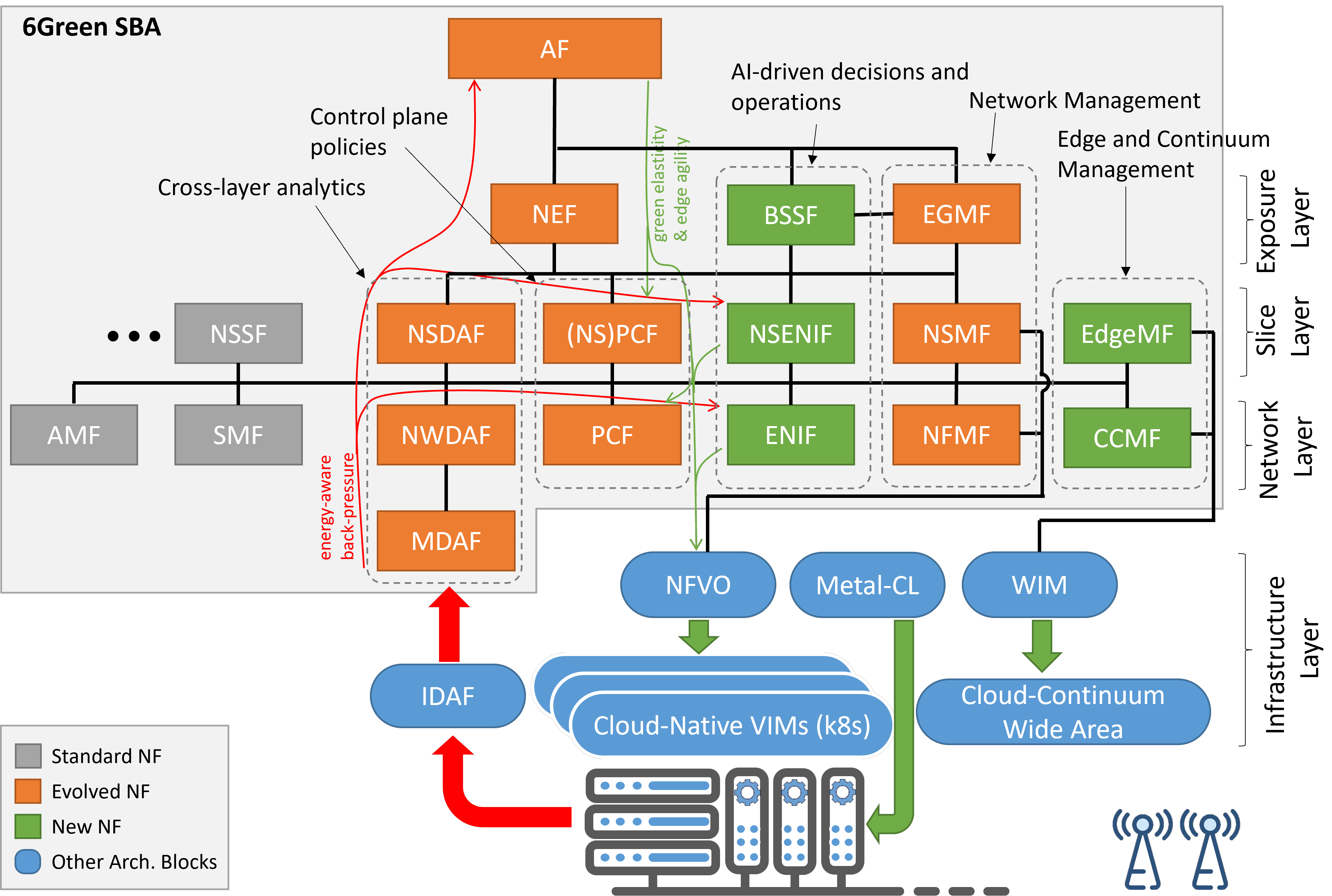
To achieve this ultimate goal, the project exploited and extended state-of-the-art cloud-native technologies and the B5G Service-Based Architecture (SBA) with new cross-domain enablers aimed at enhancing the flexibility, scalability, and sustainability of the global ecosystem. It also aimed to enable all 5/6G stakeholders, from those operating at the infrastructure and network platform level to vertical industries, to reduce their carbon footprint by becoming integral parts of a win-win green-economy business model and by meeting a Decarbonization Service Agreement (DSA). The interactions among stakeholders were designed to establish a close proportionality between the dynamic and geographically distributed (mobile) workload generated by vertical applications and network slices and the energy consumption and carbon footprint induced in the evolved SNS network and computing infrastructure.
6Green Description and Methodologies
The 6Green project envisioned the 5/6G ecosystem as a sustainable, interconnected, greener, and flexible end-to-end inter-compute system, capable of properly interfacing stakeholders through the use of latest-generation intent-based and cloud-native paradigms, and facilitating their interactions according to the aforementioned green-economy business models and agreements. This was intended to enable 5/6G vertical applications and network slices to be dynamically, scalably, and autonomously placed in the edge-cloud continuum, instantiated, modified, dimensioned, migrated, and released in a coordinated fashion, when and where they were truly needed by end-users, in order to minimize the induced impact at the infrastructure layer.
In order to shift from the then-current, flat/semi-static lifecycle management of network slices and applications towards novel and real-time adaptive operations, three ground-breaking technological innovations were identified, reflecting the structure of the project activities:
1. Edge Agility:
A sort of handover procedure was developed to provide smart, fast, and automated horizontal scalability for vertical applications and their related slices across the 5/6G edge-cloud continuum. The workload, as well as the latency budget, was redistributed according to user- or infrastructure-driven events (e.g., user mobility, seamless workload replacement/migrations, etc.). The slice/vertical application footprint was rapidly scaled to zero in unused areas of the continuum and its operating capacity was quickly resumed when needed.
2. Green Elasticity:
The provision of energy-aware, hardware-assisted acceleration to network functions and vertical applications enabled smart vertical scalability across the entire 5/6G ecosystem. By relying on hardware acceleration engines, which exhibited low power-consumption dependency on their usage, the approach enabled lower processing latency compared with pure software-based solutions and reduced energy consumption by exploiting standby/low-power modes in combination with optimal configurations and deployments.
3. Energy-Aware Backpressure:
The project designed a set of cross-domain observability mechanisms and analytics, fed by hardware-level energy consumption metrics, to evaluate the energy consumption and carbon footprint attributable to a vertical application or a slice. The introduction of green business models was intended to act as a catalyst, motivating all stakeholders to adopt environmentally conscious behaviors through economic incentives.
Three future-proof vertical applications were identified as project use cases, not only because they represented future-proof 5/6G applications that were highly relevant to energy and carbon awareness, but also because they provided challenging requirements for network slices and (edge) computing and storage facilities. These requirements could vary according to the Energy-Aware Backpressure information flows and the activated application functionalities, and could differently trigger Edge Agility and Green Elasticity zero-touch operations.